Showing posts with label census. Show all posts

Thursday, May 9, 2013

Latvian censuses: 1913, 1925,1930, 1935, 1970, 1989

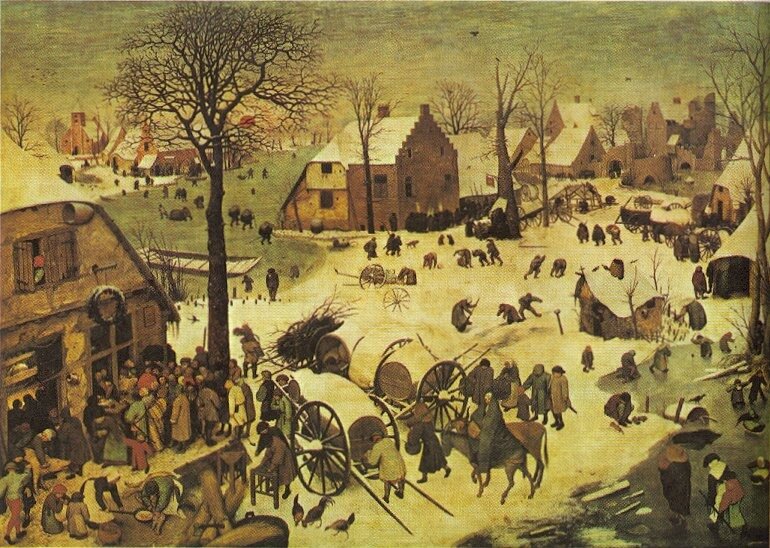
Pieter Bruegel the Elder: Census at BethlehemStolen from comments to timbes5 Live Journal

historic Latvian census results
I take a liberty to point to some Latvia's census results:
1) census in Riga and environs in 1913
2) Latvian census of 1925
3) Latvian census of 1930
4) Latvian census of 1935
5) USSR census of 1970 in Latvia
6) USSR census of 1989 in Latvia
Also I'd like to mention Latvian Statistical Atlas of 1938 which was published on 20th anniversary of Latvian independence:
* * *
Numbers of censuses 1913-1935 (4 in 22 years) and then (4 in 30 years) demonstrate an obvious difference between national and communist government. The most important is delay from 1945 to 1959.
+ there are no 1959 and 1979 censuses

Tuesday, April 2, 2013

Missing Children in North Caucasus

Window on Eurasia: ‘Missing’ Children in North Caucasus Part of Broader Problem with Russian Census, Moscow Demographer Says

Paul Goble
3 человека в минуту
Staunton, March 29 – Reports that North Caucasus officials have “lost” more than 110,000 children they claimed in 2010 were residents of their republics are part of a broader problem in which officials there and elsewhere falsified census reports in order to suggest that the Russian Federation has “at a minimum” 2.5 million more people than it in fact does.

That is just one disturbing conclusions about the results reported by the 2002 and 2010 Russian censuses which Sergey Zakharov, the director of demographic research at Moscow’s Higher School of Economics, offered in the course of an interview posted online yesterday.

Because Russia, like many other countries, does not have a population register as such, Rosstat relies “above all” on data about “demographic events” like births, deaths, and marriages, and on censuses which the constitution requires be conducted every ten years, Zakharov notes. Unfortunately, there are many problems with such data, especially that from censuses.

“It is difficult to call the 2002 and 2010 censuses good,” the demographer continues, adding that he would give them a grade of  “C-Plus.” Among the worse problems manifested in them, he says, are the efforts by officials to report that their regions and republics have more residents than in fact they do in order to obtain larger subventions from Moscow.

Among the worst offenders in this regard are leaders in the North Caucasus, a fact that has been highlighted by official discovery that those leaders have somehow misplaced tens of thousands of children they claimed in 2010. But that region is far from the only one where official malfeasance boosted the overall numbers.

That region, Zakharov says, added one million to the real number, but it was closely followed by over-reporting in Moscow and St. Petersburg.  In those cities, many people refused to “open their doors” to census takers and the original count was quite low.  Then-Moscow Mayor Yuri Luzhkov gave an order to use information contained in administrative registrars.

As a result, “many people were double counted” in the census, first by their census declarations and then by these alternative sources.  In 2002, this happened but it was illegal, Zakharov continues, but for 2010, “Rosstat completely legalized” that approach. “Otherwise, it simply couldn’t overcome the lack of willingness of the population to cooperate.”

Rosstat says that only 15 percent of the reported count in 2010 reflected the use of such alternative enumerations, “but we consider that the real figure is much greater.”

No country has ever conducted a perfect census, Zakharov says, but Russia’s problems with the collection of data mean that officials cannot come up with good policies except by accident because they do not have data about the population on which they can rely.  And both officials and demographers are aware of this.

One way to address it, he continues, is to conduct mini-censuses between those that embrace the entire country. The Soviet Union conducted one of these in 1985, and the Russian Federation plans to do one before the 2020 enumeration, focusing in particular on issues involving reproduction rates.

“The number of people born is increasing” in Russia, Zakharov says. “But whether this means an increase in the birthrate is a big question because it is no secret that Russia is at crest of a demographic wave,” in which the large generation of Russian women born in the 1980s is having children.

Indeed, it seems likely that “the average number” of children per woman “is not changing although the absolute number of births is increasing” because there are more Russian women now in the prime childbearing years of their lives.  When their number declines as it will, Zakharov says, so too will the number of births.

The Russian government’s pro-natalist policies, including “maternal capital,” are unlikely to change that, the demographer says. They may change when women have children but not how many.  To affect the overall number, he says, requires first of all “a struggle with poverty” and even a return to a more rural lifestyle, something which is unlikely to occur.

Russian women have a fertility rate of 1.6 percent, far below the 2.1 children per woman per lifetime needed to keep the population stable as well as below the 2.6 children per married couple per lifetime. Zakharov adds that “no more than 15 percent” of Russian women want three children or more, something far more would need to want to make a difference.

Consequently, expecting as some Russian officials do that they make the three-child family the norm or even more common is “completely utopian,” as the numbers show and as international experience confirms.

Monday, February 25, 2013

post Soviet censuses of Russia's population

Two censuses of Russia's population took place since the USSR collapse, in 2002 and in 2010. The last Soviet census had beeb carried out in 1989. In this case census means population count, generally census meaning is wider, including preparations, count, analyses, publication, dissemination, et al.
The very first observation, time span between censuses varies.
The second - population count revealed extra population in both censuses, in 2002 bigger than in 2010.
Then usual census deficiencies are also here: age accumulation, higher age of the aged, children undercount, double count mainly of youngsters (military servants and students). Comparisons of census's results with vital statistics and other independent data sources reveal unexplainable differentials. However, Rosstat have found just one explanation -- migration, which seems weak.
Obtained results are hardly reliable, but unfortunately other data sources are dubiously more reliable. The results are more reliable at the national level than at a regional level. The smaller the region the less the reliability.
Imho:
The major source of a census quality deterioration is rejection of counting two populations: de jure and de facto, in favor of de jure.
I do not believe in a conspirology and intentional distortions in terms of power vertical, but local under and over counting of certain groups (e.g., ethnic) is common for a census.
Census results remain the best possible sampling frame for a general population based survey. There are likely other frames for focused surveys.
Pieter Bruegel the Elder: Census at Bethlehem

Demoscope collected many reactions on both censuses, have a look at 2002, 2010.

Wednesday, January 30, 2013

2011 Census: England and Wales

Key Figures

  • Ninety two per cent (49.8 million) of usual residents aged three years and over spoke English (English or Welsh in Wales) as their main language.
  • Of the eight per cent (4.2 million) of usual residents aged three years and over with a main language other than English, 79 per cent (3.3 million) could speak English very well or well.
  • In 2011, less than half a per cent (138,000) of all usual residents aged three years and over could not speak English.
  • The second most reported main language was Polish (one per cent, 546,000), followed by Panjabi (half of one per cent, 273,000) and Urdu (half of one per cent, 269,000).
  • A small percentage (22,000) of usual residents reported a sign language as their main language; of these usual residents 70 per cent (15,000) used British Sign Language.
  • Thirteen per cent (7.1 million), of usual residents in households in 2011 lived in one person households, the same percentage as in 2001 (13 percent, 6.5 million).
  • The percentage of usual residents in households who were part of a one family married couple household, where at least one household member was aged under 65 years, decreased by six percentage points from 50 per cent (25.3 million) in 2001 to 44 per cent (24.4 million) in 2011.
  • The percentage of usual residents in households who were part of a one family cohabiting couple household, where at least one household member was aged under 65 years, increased by two percentage points from ten per cent (4.9 million) in 2001 to 12 per cent (6.5 million) in 2011.
  • The percentage of usual residents in households who were part of a one family lone parent household, where at least one household member was aged under 65 years, increased by one percentage point from 11 per cent (5.4 million) in 2001 to 12 per cent (6.5 million) in 2011.
  • In 2011, seven per cent (3.7 million) of usual residents in England and Wales were 16 to 74 year old full-time students compared to five per cent (2.6 million) in 2001. Of the 16 to 74 year old full-time students in 2011, 29 per cent (1.1 million) reported that they were employed at the time of the census.
  • In 2011, the majority of 16 to 74 year olds in employment travelled to work by driving a car or van (58 per cent, 15.3 million). The second most reported method of travel to work for 16 to 74 year olds in employment was by foot (11 per cent, 2.8 million), whilst the third was travel by bus, minibus or coach (seven per cent, 1.9 million).
Get all the tables for this publication in the data section of this publication .

Thursday, May 26, 2011

Danger in Census

ЗбарскаяYesterday I attended a session of demographic section of DURAN, where Zbarskaya (chief of census administration, see pic) reported on the results of recent census.

Core result, imho, = the census again counted about a million more than Rosstat previously expected. This extra population they attributed to immigration, that is, unnoticed million came to Russia in past eight years, or more than 100 000 per year.

Another curious statement: governors (heads of territories) realized that the population is a a source of federal money transfers, and furiously fight for budget.
Best fighter is the Ingush boss (very popular due to seizure of Pristina airport), for this reason the chief of the local statistics body designated federal protection (body guard), and the family was taken to Moscow. However, the population of Ingushetia during the intercensal period decreased. Nabiulina writed to Putin: no reasons to recount census in Ingushetia.